Six months earlier, Daniel had been exactly where you might be right now: excited about his idea, terrified of choosing the wrong development team, and overwhelmed by the sheer number of MVP app developers claiming they could turn his vision into reality.
He’d done his homework. He’d compared pricing. He’d checked portfolios. He’d even asked for references. And yet, here he was at midnight, staring at a half-built product that had already consumed $127,000 of his $200,000 seed round, MVP app developers with nothing to show investors except excuses and missed deadlines.
“The worst part wasn’t the money,” Daniel told me over coffee two months later, after he’d started over with a different team. “It was realizing I’d wasted six months. My competitor launched three weeks ago. They used the same tech stack I’d planned, executed my exact positioning strategy, MVP app developers and they’re already at 4,000 users. I should have been first to market. Instead, I’m scrambling to catch up because I chose the wrong MVP app developers.”
Daniel’s story isn’t unique. According to research on startup failures, 42% of startups fail because they build products nobody wants—but an almost equal number fail because they choose development partners who can’t execute their vision efficiently. The difference between these scenarios? One is a market problem. The other is a partnership problem that’s entirely preventable.
This is your guide to choosing MVP app developers who will actually help you succeed, written by someone who’s seen both sides of this equation and learned these lessons through painful, expensive experience.
What Makes MVP App Developers Different (And Why Most Founders Get This Wrong)
Here’s the uncomfortable truth that most development agencies won’t tell you: building an MVP requires a fundamentally different skillset than building enterprise software or consumer applications.
When you hire MVP app developers, you’re not just hiring people who can write code. You’re hiring strategic partners who understand the unique pressures, constraints, and objectives of early-stage startups. And that’s where most founders make their first critical mistake.

MVP app developers operate under completely different constraints. They’re optimized for speed, learning, and capital efficiency. They know how to identify your riskiest assumptions, build only what’s necessary to test those assumptions, and help you make data-driven decisions about what to build next.
Jessica learned this distinction the hard way. She hired a prestigious development agency with an impressive portfolio of Fortune 500 clients. “They were amazing developers,” she explained. “Every line of code was beautifully written. Their architecture was incredibly sophisticated. The problem? They spent three months building a user authentication system with enterprise-grade security features when I needed to validate whether anyone would even sign up for my platform.”
The agency wasn’t incompetent—they were just optimized for the wrong outcome. They gave Jessica exactly what she asked for: professional, scalable code. But what she actually needed was MVP app developers who would challenge her assumptions, help her identify the minimum features necessary to test her hypothesis, and get her to market in weeks, not months.
The Five Questions That Reveal Whether MVP App Developers Actually Understand Startups
After working with dozens of founders who’ve hired (and fired) multiple development teams, I’ve identified five questions that consistently separate MVP app developers who truly understand the startup game from those who are just claiming they do.
Ask these questions in your initial conversations. Pay attention not just to what they say, but to how they react to the questions themselves.
Question 1: “How do you decide what features to include in an MVP?”
Weak answer: “We build whatever you tell us to build. Just give us your requirements document and we’ll provide a quote.”
This response reveals order-takers, not strategic partners. True MVP app developers should push back on your feature list, interrogate your assumptions, and help you identify the absolute minimum needed to test your core hypothesis.
Strong answer: “We start by understanding your riskiest assumption—the thing that, if wrong, would invalidate your entire business model. Then we design the leanest possible experiment to test that assumption. Often, the right MVP doesn’t include half the features founders initially think they need.”
Marcus, who built a successful fintech app, told me about this exact conversation with the team that eventually became his MVP app developers: “When I showed them my 47-feature specification document, they didn’t give me a quote. They scheduled a three-hour working session to understand my business model, identify my biggest risks, and help me descope to 8 core features. I was frustrated at first—I wanted them to just build what I asked for. Looking back, that consultation saved me six months and probably $200,000.”
Question 2: “What happens when we discover our initial assumptions were wrong?”
Weak answer: “We can discuss change orders and provide revised quotes based on the new requirements.”
This approach treats pivots as expensive disruptions rather than expected learning opportunities. It reveals developers who are optimized for fixed-scope contracts, not iterative discovery.
Strong answer: “That’s exactly what MVPs are for—learning what’s actually needed. We structure our engagements with built-in flexibility for iteration. We expect that roughly 30-40% of initial features will either change significantly or be replaced based on what we learn from real users. Our process is designed to make those pivots fast and cost-effective.”
Question 3: “How do you handle technical debt in MVPs?”
Weak answer: “We build everything to production-quality standards from day one to avoid technical debt.”
This sounds responsible but reveals a fundamental misunderstanding of MVP strategy. Building production-quality everything before you’ve validated product-market fit is wasteful.
Strong answer: “We make strategic decisions about where to accept technical debt and where to invest in quality. User-facing features that test core assumptions can be built scrappy. Infrastructure for analytics, deployment, and iteration needs to be solid because you’ll rely on it for learning. We’re explicit about these trade-offs and help you understand the implications.”
Question 4: “What metrics do you track to measure MVP success?”
Weak answer: “We deliver on time, on budget, and according to spec. We measure our success by whether the code works as designed.”
This reveals developers who measure success by delivery, not by business outcomes. Your MVP’s success isn’t defined by whether it works—it’s defined by what you learn from it.
Strong answer: “We help you define success metrics before writing a single line of code. These might include user activation rates, feature engagement, retention, conversion rates, or qualitative feedback themes. We build analytics from day one and structure our development sprints around improving these metrics, not just adding features.”
Question 5: “Can you show me an example of an MVP you built that failed, and what you learned?”
Weak answer: “All our projects are successful. We have a 100% client satisfaction rate.”
This is either dishonest or reveals a team that’s never worked on real MVPs. In the MVP world, many experiments “fail” in the sense that they invalidate hypotheses—but that’s valuable learning, not failure.
Strong answer: “We worked with a startup building a social fitness app. We shipped an MVP in 8 weeks that technically worked perfectly but got almost no user engagement. Through analytics and user interviews, we discovered people didn’t want another social network—they wanted coaching. We helped the founder pivot to a different model, and that became a successful product. The MVP didn’t validate the original idea, but it did its job: it prevented the founder from wasting a year building the wrong thing.”
The Real Cost of MVP App Developers in 2026 (And Why Cheap Always Costs More)
Let’s address the elephant in every founder’s budget spreadsheet: how much should you actually pay MVP app developers?
I’ve seen founders make devastating mistakes on both ends of this spectrum. Some pay $200 per hour for enterprise developers building features they don’t need. Others pay $25 per hour for offshore teams who produce code that has to be completely rewritten.
Here’s what realistic MVP app development actually costs in 2026, based on current market rates and dozens of recent projects:
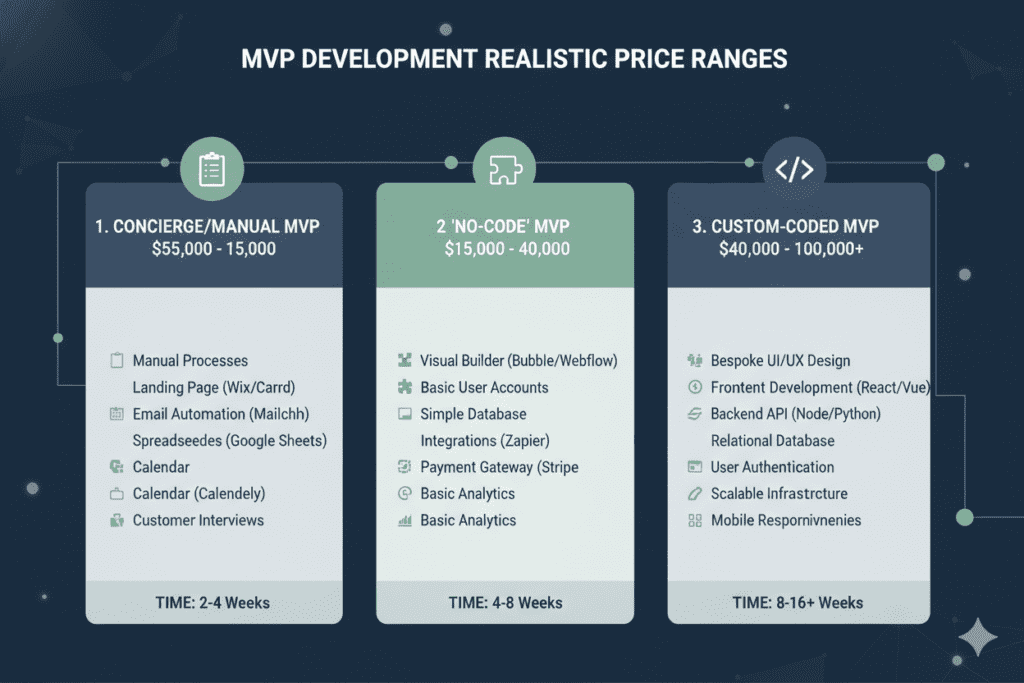
Sometimes the right MVP isn’t code at all. Many successful products started as landing pages with Stripe integration and manual service delivery. This validates willingness to pay before you invest in automation.
Timeline: 1-3 weeks What you get: Professional landing page, payment integration, email automation, manual backend processes Best for: Service businesses, marketplaces, content platforms Example: Sarah validated her career coaching platform for $8,000 by manually delivering sessions she’d eventually automate
Simple Web App MVP: $25,000 – $65,000
A functional web application with user accounts, core workflow, database, and analytics. This is your first real product that users can interact with independently.
Timeline: 6-10 weeks What you get: User authentication, 3-5 core features, admin dashboard, responsive design, deployment Best for: SaaS tools, internal business software, community platforms Example: Thomas built his project management MVP for $42,000 and validated demand with 200 paying beta users
Mobile App MVP (Cross-Platform): $45,000 – $95,000
A native or cross-platform mobile app with backend API, push notifications, and app store deployment. Using React Native or Flutter instead of separate native apps cuts costs significantly.
Timeline: 8-14 weeks What you get: iOS + Android apps, backend API, user accounts, push notifications, analytics, app store submission Best for: Consumer apps, mobile-first services, location-based products Example: Lisa’s food delivery MVP cost $68,000 using React Native, versus $140,000 quotes for separate native apps
Marketplace or Multi-Sided Platform: $65,000 – $150,000
Platforms connecting different user types (buyers/sellers, clients/providers) with matching, messaging, payments, and reviews.
Timeline: 12-18 weeks What you get: Separate experiences for each user type, search/matching, in-app messaging, payment processing, rating system Best for: Freelance platforms, rental marketplaces, service marketplaces Example: David’s freelancer platform MVP was $87,000 and reached profitability in 5 months
These numbers might seem high if you’ve seen $5,000 MVP quotes online. Here’s why those ultra-cheap options almost always fail:
A $5,000 MVP typically means one of three things: (1) offshore developers who don’t understand your market or business context, (2) junior developers learning on your dime, or (3) agencies that will nickel-and-dime you with change orders until the total cost exceeds what quality developers would have charged upfront.
Rachel experienced this firsthand. She hired a $12,000 development team for her healthcare app MVP. “The initial quote was incredibly cheap,” she explained. “But they didn’t include user authentication. Or payment processing. Or the admin dashboard. Or proper analytics. Every time I asked about something that seemed obviously necessary, it was an extra charge. I ended up paying $68,000 for an inferior product that I eventually had to rebuild entirely with different MVP app developers who charged $55,000 but delivered something actually usable.”
Red Flags That Scream “Wrong MVP App Developers” (Ignore These At Your Own Risk)
Here are the red flags that should make you walk away, no matter how impressive the portfolio or how attractive the pricing:
Red Flag #1: They Quote Without Understanding Your Business Model
If MVP app developers can give you a detailed quote after a 30-minute call where they barely asked about your business model, your target users, or your core assumptions, they’re not actually listening. They’re pattern-matching your request to their standard offerings.
Quality MVP app developers should push back. They should ask uncomfortable questions. They should make you explain why you think certain features matter. The quote should come after they understand your business, not before.
Red Flag #2: They Don’t Ask About Your Validation Strategy
If potential MVP app developers never ask how you plan to test your MVP, how you’ll measure success, or what you’ll do with the learnings, they see themselves as order-takers, not strategic partners.
The conversation should include: What’s your riskiest assumption? How will you validate it? What metrics will indicate success or failure? What’s your plan for user acquisition? How will you gather feedback?
If these topics never come up, you’re talking to developers, not MVP app developers.
Red Flag #3: Their Portfolio Shows Only Polished, Feature-Complete Products
Beautiful portfolio apps with dozens of features aren’t necessarily a good sign for MVP work. They might indicate a team that builds complete products for established companies, not lean experiments for startups.
Look for portfolios that show evolution: “Here’s version 1 with 3 features, here’s what we learned, here’s version 2 with different features based on user feedback.” That story demonstrates understanding of the MVP process.
Red Flag #4: They Promise Unrealistic Timelines
“We can build your full-featured marketplace app in 4 weeks” is almost always a lie or a severe misunderstanding of scope. Quality MVP app developers set realistic expectations.
For reference: A simple MVP takes 6-10 weeks minimum. A complex MVP might take 12-18 weeks. Anyone promising dramatically faster delivery is either cutting critical corners or planning to deliver something far less functional than you’re imagining.
Red Flag #5: They Don’t Discuss Post-Launch Support
Your MVP launch isn’t the finish line—it’s the starting line for learning. If MVP app developers treat handoff as the end of the project, they don’t understand the iterative nature of product development.